
 Español
  عربى
عربى 



Industry News
Home / News / Industry News / Thermal Processing Industry Guide: Equipment, Temperature Tolerances & Compliance
Thermal Processing Industry Guide: Equipment, Temperature Tolerances & Compliance
Date:Sep 28, 2026
A batch furnace set to 650 °C that runs 628 °C at the door and 671 °C at the back wall is not dealing with a small calibration problem. Across a 45-minute soak, that spread decides whether a tool steel lot meets its hardness specification or comes back as rework. That gap is the daily reality of the thermal processing industry, and it explains why the setpoint on the controller is usually the least informative number in the room.
Thermal processing covers any operation in which controlled heat, and usually a controlled atmosphere or a vacuum, changes a material. It spans heat treating and sintering of metals, pasteurization, sterilization and blanching in food, drying and curing in battery and coating production, and the bake, degas and anneal steps behind semiconductor and thin-film manufacturing. The hardware looks different in each segment, but the physics and the purchasing risks are remarkably similar.
The practical conclusion: thermal processing is a tolerance business, not a temperature business. Four variables decide whether a process repeats itself — achievable uniformity, atmosphere control, the match between load geometry and heat transfer, and documented proof that all three held during the run. Buyers who select equipment around those four points, instead of around a maximum temperature alone, avoid most of the expensive surprises.
Content
The Four Variables That Decide a Thermal Process
Before comparing catalogue numbers, it helps to separate what actually changes the outcome of a cycle. Each of the four items below can invalidate an otherwise well-specified purchase.
Uniformity band
Uniformity is quoted as a band across a defined working volume, for example +/- 3 °C, +/- 5 °C or +/- 10 °C. A chamber rated to 300 °C with no stated band tells a buyer almost nothing. The band also depends on the load: an empty chamber always looks better than a loaded one.
Atmosphere
Air is the cheapest atmosphere and the most chemically aggressive. Nitrogen suppresses oxidation, hydrogen and forming gas reduce surface oxides, and vacuum removes both oxygen and the volatiles that escape from the load. The material specification, not workshop convenience, should decide this.
Heat transfer geometry
Convection needs space for gas to move, radiation depends on line of sight to the elements, and conduction depends on contact pressure. Stacking parts tighter to raise throughput often changes the effective process more than raising the setpoint does.
Evidence and traceability
Auditors and customers ask for temperature uniformity surveys, thermocouple calibration records and continuous data logs. A process nobody can document is, for practical commercial purposes, a process nobody can sell.
Matching Equipment to the Process
Equipment builders such as Shanghai Dengsheng Instrument Manufacturing, whose thermal equipment line runs from drying ovens and vacuum chambers to furnaces, incubators and test chambers, tend to organize their catalogues the same way: by family, not by temperature alone. The comparison below summarizes where each family earns its place.
Table note: these ranges are starting points, not guarantees. Real working limits shift with load mass, insulation quality, controller tuning and the uniformity class the buyer asks the supplier to certify.
Vacuum is the clearest example of why the physics matters more than the label. Lowering chamber pressure lowers the boiling point of water and solvents, so a vacuum dryer can remove moisture at 60 °C that an atmospheric oven would need 140 °C to shift. The same environment also removes oxygen, which stops oxidation on reactive powders and prevents surface discoloration on copper and silver parts.
 Exquisite Appearance Flexible and Convenient Vacuum Drying OvenThis product features a vertical, floor-standing design, efficiently integrating the vacuum pump and working chamber into a single, compact structure. This eliminates ...View Product →
The trade-off is cycle structure. Vacuum drying removes heat transfer by convection, so heating relies on shelves, radiation and contact, and the pump becomes a maintenance item with oil or seal replacement intervals. A process engineer who plans for that gets a fast, clean, low-temperature cycle. One who does not inherits unpredictable pump downtime.
Reliability work follows a different logic again. Test chambers are specified by the stress profile they must reproduce, not by a single temperature, and that is why a plant will often run several chamber types side by side. A useful orientation on how these variants divide up the work is covered in this overview of environmental test chamber types.
Hidden Metrics: Where Cycle Time and Cost Actually Sit
Quotation sheets rarely show the distribution of time inside a cycle, yet that distribution explains most operating cost. In a typical convection cycle for a medium-mass load, the breakdown looks roughly like this.
Ramp-up
30%
30%
Soak
32%
32%
Cooling
18%
18%
Load and unload
12%
12%
Records and QA
8%
8%
Two conclusions follow. First, ramp-up is where energy demand peaks and where better door seals, thicker insulation and correctly sized recirculation fans pay for themselves. Second, cooling is where distortion and residual stress are usually introduced, which is why controlled cooling is a process parameter rather than a waiting period.
A third metric stays invisible until the first audit: the time required to prove the chamber is still what it was when it was installed. Plants that log uniformity surveys and calibration dates in the same system as production runs spend hours preparing for an audit instead of days.
How Thermal Processing Demand Is Distributed
The industry is often discussed as if it were one market. In practice, demand concentrates in four clusters with quite different specifications, service expectations and compliance burdens.
- Metals heat treating and sintering: about 34 percent
- Food, pharmaceutical and sterilization processes: about 27 percent
- Semiconductor, electronic and new-material processing: about 21 percent
- Aerospace, automotive and general reliability validation: about 18 percent
The semiconductor and new-material share is the fastest to change specification. Battery electrode drying, for example, has moved toward lower oxygen levels and tighter temperature bands because residual moisture and surface oxidation both degrade cell performance. That pushes buyers toward nitrogen-purged or class-100 clean drying equipment rather than a standard workshop oven.
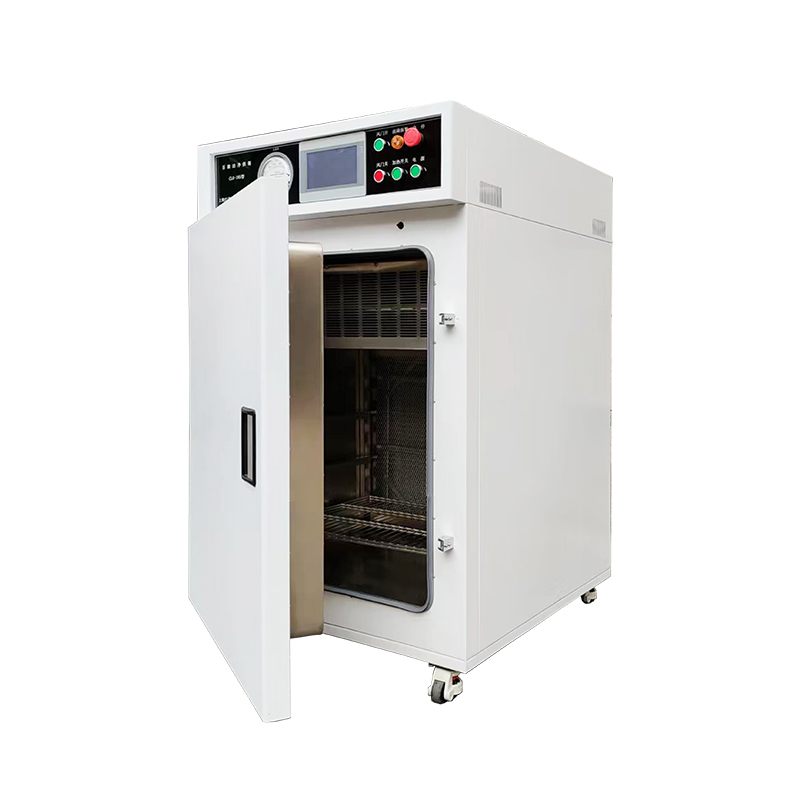 250℃ High Temperature Resistant Class 100 Clean Drying OvenThe Class 100 Cleanroom Drying Oven, also known as a Class 100 Cleanroom Baking Oven or Class 100 Cleanroom Drying Cabinet, is a special equipment that integrates high...View Product →
Food and pharmaceutical thermal processes sit at the other extreme of documentation. Pasteurization regimes, sterilization lethality values and container integrity checks are all recorded against a defined procedure, so the equipment is judged on reproducibility and record quality as much as on heating speed.
A Selection Sequence That Avoids Expensive Mistakes
Most procurement problems in this industry trace back to a sequence error: the chamber is chosen before the process window is defined. Working in the order below keeps the decision grounded.
1
Write down the process window
State the target temperature, the permitted band, the soak duration, the maximum ramp rate the material tolerates and the atmosphere. If the band cannot be stated, the process is not yet defined well enough to buy equipment for.
2
Measure the load, not the chamber
Load mass, rack material and stacking pattern determine how much heat the system must move. A chamber that holds temperature perfectly when empty can fall several degrees short with 200 kg of steel inside.
3
Match the atmosphere to the risk
Solvent vapours, fine powders and reactive gases change the enclosure requirement entirely. Where flammable concentrations can form, standard heating equipment is the wrong answer regardless of its temperature rating.
4
Confirm the documentation scope
Ask which uniformity class will be certified, which survey method will be used, and what calibration certificates accompany the unit. These answers often separate two quotes that look identical on price.
5
Model the payback honestly
Illustrative arithmetic: a chamber running two 20-rack cycles per day with USD 200 of work in process per rack handles USD 8,000 daily. Cutting scrap by one percent frees roughly USD 80 per day, about USD 20,000 over a 250-day year, which frequently exceeds the price premium for a tighter, better-documented unit.
For solvent-bearing loads in classified areas, the enclosure, the fan, the controller and the wiring all have to meet the same protection standard. Splitting one rated component into an otherwise standard chamber is a common and costly shortcut.
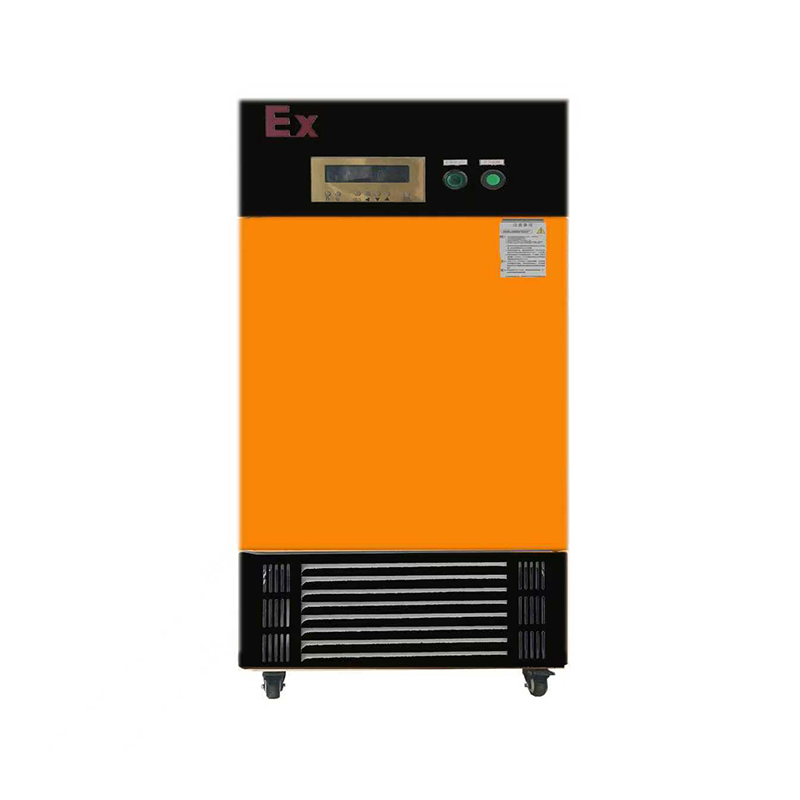 Explosion-proof High and Low Temperature and Humidity Test ChamberThe explosion-proof high and low-temperature test chamber is a critical piece of equipment for modern industrial safety and precision testing. Its multi-layered active...View Product →
Maintenance and Compliance: The Unglamorous Part
A thermal process degrades quietly. Nothing fails outright; the band simply widens by a degree or two per year until a batch is out of specification. Scheduled maintenance is what keeps the process inside the window defined at commissioning.
- Repeat the temperature uniformity survey at the interval the applicable standard or customer requirement sets, and after any change to insulation, fans or door hardware.
- Recalibrate control and survey thermocouples on a documented schedule; drifting sensors are the most common cause of a widening band.
- Replace door gaskets and seals on condition, not on failure. Seal compression is cheap to check and expensive to ignore.
- Service vacuum pumps, filters and blowers on hour-based intervals, and record oil changes as part of the process history.
- Keep continuous temperature records, calibration certificates and maintenance logs in one archive that auditors can follow without assistance.
For manufacturing sites, the quality system is the backbone of all of this. A facility operating under ISO 9001 with its own test laboratory is normally able to run uniformity surveys and acceptance tests before shipment, which reduces the risk of a chamber arriving with an unverified band. It is worth asking a supplier directly which tests are performed in-house, what instrumentation is used, and whether those records travel with the unit.
Explosion-protected installations add a second layer: enclosure integrity, purge systems, interlock logic and cable glands all need periodic inspection, and any field modification can invalidate the original certification. Treating that certification as a permanent property of the equipment rather than a condition to be maintained is a reliable way to fail an audit.
The thermal processing industry rewards precision in a specific way. Two plants can buy technically similar chambers and end up with completely different yields, because one defined its process window before the purchase and the other expected the equipment to define it. The order of operations matters more than the brochure.
Start with the tolerance you can actually hold, choose the atmosphere and heat transfer method that the material demands, document everything the process produces, and maintain the system as a process asset rather than a utility. That approach keeps a furnace, an oven or a test chamber doing what it was bought to do five years after installation, which is the only performance figure that ultimately counts.
Send Message
Recommended Products
Products provided by famous enterprises are deeply trusted by users.

- CONTACT
-
- No. 119, Qingliang Avenue, Yaozhuang Town, Zhejiang, China.
- [email protected] ( Email )
- +86-13671719019 ( Phone )
- +86-021-57440136 ( Tel )
- PRODUCT
-
- Drying Oven Series
- Vacuum Box Series
- Explosion-proof Series
- High-temperature Furnace Series
- Incubator Series
- Test Chamber Series
- Other Series
- Forced Air Drying Oven
- Resistance Furnace
- Vacuum Tube Furnace
- Mold Incubator
- Vacuum Atmosphere Furnace
- Biochemical Incubator
- Carbon Dioxide Incubator
- Explosion-Proof Vacuum Drying Oven
- High and Low Temperature Test Chamber
- MOBILE
Copyright ©
Shanghai Dengsheng Instrument Manufacturing Co., Ltd.
All Rights Reserved. Laboratory Equipment Manufacturers

 Back to Top
