
 Español
  عربى
عربى 



Industry News
CO2 Incubator: Temperature, Humidity & Gas Control for Cell Culture
Date:May 19, 2026
Mammalian cells are unforgiving. A pH shift of 0.2 units can slow proliferation; a temperature deviation of 1°C can alter protein expression; humidity below 85% accelerates media evaporation fast enough to concentrate salts to toxic levels within days. The CO2 incubator exists precisely to prevent these failures—not by controlling one variable, but by maintaining three interdependent parameters simultaneously and continuously.
Understanding how those three parameters interact, which technologies control them most reliably, and what to look for when specifying a unit is the difference between a cell culture program that produces reproducible data and one that doesn't.
Content
- 1 What a CO2 Incubator Actually Controls—and Why All Three Parameters Matter
- 2 Temperature Stability: The Foundation of Reproducible Cell Culture
- 3 CO2 Concentration Control: IR Sensors vs Thermal Conductivity Sensors
- 4 Humidity Management: Why 95% RH Is the Target
- 5 Contamination Control: HEPA Filtration and Decontamination Cycles
- 6 Key Applications: From Cell Lines to IVF to Drug Screening
- 7 Dengsheng CO2 Incubators: Specifications and Selection Guide
What a CO2 Incubator Actually Controls—and Why All Three Parameters Matter
The three core parameters of a CO2 incubator—temperature, CO2 concentration, and relative humidity—are not independent. They are linked through the chemistry of the culture medium itself, specifically the bicarbonate buffering system used in virtually all standard mammalian cell culture media.
Sodium bicarbonate in the culture medium reacts with dissolved CO2 to maintain pH according to the Henderson-Hasselbalch equation. At 5% atmospheric CO2 and 37°C, this reaction stabilizes media pH at approximately 7.2–7.4—the physiological range for most mammalian cell types. If CO2 concentration drops, pH rises; if CO2 rises, pH falls. If temperature shifts, the equilibrium constant changes. If humidity is too low, media evaporates and bicarbonate concentrates, pushing pH higher still.
This means a CO2 incubator cannot be evaluated on any single parameter. A unit that holds 37°C precisely but allows CO2 to drift ±0.5% will produce pH swings that compromise cell viability. A unit with excellent CO2 control but poor humidity recovery after door openings will cause progressive media concentration in longer cultures. All three systems must perform together.
Temperature Stability: The Foundation of Reproducible Cell Culture
Standard mammalian cell culture targets 37°C—human body temperature—because that is where the enzymes, receptors, and metabolic pathways of most human and primate cell lines operate optimally. Deviations matter more than most researchers appreciate: a sustained 0.5°C elevation accelerates metabolic rate and can trigger heat-shock protein responses; a 1°C drop noticeably slows proliferation in sensitive primary cells.
Two heating architectures dominate the CO2 incubator market, each with distinct performance characteristics:
- Water-jacketed systems surround the chamber with a layer of heated water, which acts as a thermal buffer. Because water has high heat capacity, temperature inside the chamber recovers slowly after a door opening but remains exceptionally stable during undisturbed operation. These systems are preferred for long-term cultures, IVF, and any application where stability over days or weeks takes priority over rapid recovery.
- Direct-heat (air-jacketed) systems use heating elements distributed around the chamber walls, base, and door. They recover temperature faster after door openings—critical in high-access environments where researchers open the incubator frequently. Modern direct-heat designs with six-sided heating achieve uniformity specifications comparable to water-jacketed models at steady state.
Regardless of heating architecture, the key performance specifications to evaluate are temperature uniformity (±0.25°C or better across the chamber at steady state), temperature stability (±0.1°C variation over time at setpoint), and recovery time after a 30-second door opening. Independent temperature safety devices—a second sensor that cuts power if the primary circuit overheats—are essential for protecting long-term or irreplaceable cultures.
CO2 Concentration Control: IR Sensors vs Thermal Conductivity Sensors
CO2 concentration is typically maintained at 5% for standard mammalian culture, though some applications—hypoxia studies, certain stem cell protocols—require different setpoints. Two sensor technologies govern how accurately and reliably that concentration is maintained:
| Characteristic | Infrared (IR) Sensor | Thermal Conductivity (TC) Sensor |
|---|---|---|
| Measurement principle | Optical absorption of CO2 at specific wavelength | Difference in heat conductance between gas mixtures |
| Humidity sensitivity | Low — reads CO2 independently of humidity | High — humidity changes affect readings |
| Calibration frequency | Less frequent; stable over time | More frequent; drifts with humidity changes |
| Recovery after door opening | Fast, accurate reading resumes quickly | Slower; humidity fluctuation distorts reading temporarily |
| Typical application | High-frequency access, long-term culture, IVF | Low-access, stable-humidity environments |
IR sensors are now the standard in modern CO2 incubators for good reason: because they measure CO2 concentration optically rather than thermally, they are immune to the humidity swings that occur every time the door is opened. TC sensors remain serviceable in environments with stable access patterns, but require more disciplined calibration schedules to maintain accuracy. For any lab running frequent access protocols or sensitive primary cell lines, IR sensing is the reliable choice.
Humidity Management: Why 95% RH Is the Target
Relative humidity in a CO2 incubator is typically maintained at 95–98%, and this target is not arbitrary. At 95% RH, evaporation from open culture dishes and multi-well plates is slow enough that media composition remains stable over the culture period. Drop to 80% RH and evaporation rate increases approximately fourfold—fast enough to produce measurable osmolarity shifts within 48 hours in standard 96-well plates.
The consequences of low humidity in cell culture are specific and serious. As water evaporates from the media, sodium chloride and bicarbonate concentrate. Osmolarity rises above the 280–320 mOsm/kg range that most mammalian cells tolerate, triggering osmotic stress responses. In sensitive lines—primary neurons, induced pluripotent stem cells, embryos in IVF protocols—this stress is sufficient to arrest proliferation or initiate apoptosis.
Humidity is generated passively in most incubators by an open water reservoir in the base of the chamber. The key performance parameter is recovery speed after a door opening, which temporarily drops humidity as ambient air enters the chamber. High-performance units restore humidity to setpoint within 2–5 minutes; slower recovery systems may take 15–20 minutes, during which edge wells in multi-well plates experience disproportionate evaporation. Reservoirs should use sterile distilled water and be inspected and refilled on a defined schedule—the water reservoir is one of the most common contamination entry points in poorly maintained incubators.
Contamination Control: HEPA Filtration and Decontamination Cycles
Contamination is the most disruptive failure mode in cell culture—a single contamination event can destroy weeks of work and force disposal of irreplaceable primary cells or patient-derived samples. CO2 incubators address contamination risk through several independent mechanisms:
- HEPA filtration: High-efficiency particulate air filters installed in the chamber's airflow circuit trap particles down to 0.3 μm with 99.97% efficiency, removing airborne fungal spores, bacteria, and particulate contaminants from circulating air. Units with active HEPA filtration reduce bioburden in the chamber continuously during operation, not just during decontamination cycles.
- High-temperature decontamination: Many modern CO2 incubators include a 90°C or 180°C moist-heat decontamination cycle that sterilizes the inner chamber, shelves, and humidity pan in place without chemical agents. A 90°C cycle with high humidity achieves effective decontamination of most vegetative bacteria and fungi within 8–10 hours; 180°C dry cycles address more resistant organisms. These cycles replace the time-consuming manual disassembly and autoclave sterilization previously required.
- Copper alloy inner surfaces: Copper and copper alloys exhibit inherent antimicrobial activity through oligodynamic action—copper ions released from the surface disrupt bacterial cell membranes and fungal spore germination. Incubators with copper-lined chambers or copper shelving maintain lower baseline bioburden between decontamination cycles compared to stainless steel alternatives.
- UV irradiation: Some models include internal UV lamps for supplemental surface decontamination. UV is effective against surface contamination but does not penetrate deep into corners or below shelf surfaces, making it a complement to—not a replacement for—thermal decontamination cycles.
Key Applications: From Cell Lines to IVF to Drug Screening
The CO2 incubator's ability to replicate physiological conditions makes it indispensable across a wider range of applications than is often recognized:
- Standard mammalian cell culture: Immortalized cell lines (HeLa, CHO, HEK293), primary cells, and patient-derived samples all require CO2 incubation for routine maintenance and expansion. This is the highest-volume application in research and biopharmaceutical manufacturing.
- Stem cell research: Human embryonic stem cells and induced pluripotent stem cells are particularly sensitive to environmental fluctuations. Hypoxic culture conditions (2–5% O2) required for some stem cell protocols demand incubators with active O2 control in addition to CO2 and temperature regulation.
- In vitro fertilization (IVF): Embryo culture for human IVF uses CO2 incubators with the tightest available temperature and pH tolerances. Even brief excursions outside the target range can compromise embryo development. Purpose-designed IVF incubators often feature individual culture chambers or benchtop mini-incubators that minimize the impact of door openings on individual samples.
- Drug screening and toxicology: High-throughput screening assays run in 96- or 384-well plates require uniform conditions across every well to produce statistically valid dose-response data. Temperature and humidity gradients across the incubator shelf translate directly into edge effects that compromise assay reproducibility.
- Microbiology and pathogen research: Controlled CO2 and temperature environments support the culture of fastidious organisms and enable standardized infection models in biosafety-cabinet-compatible incubator configurations.
Dengsheng CO2 Incubators: Specifications and Selection Guide
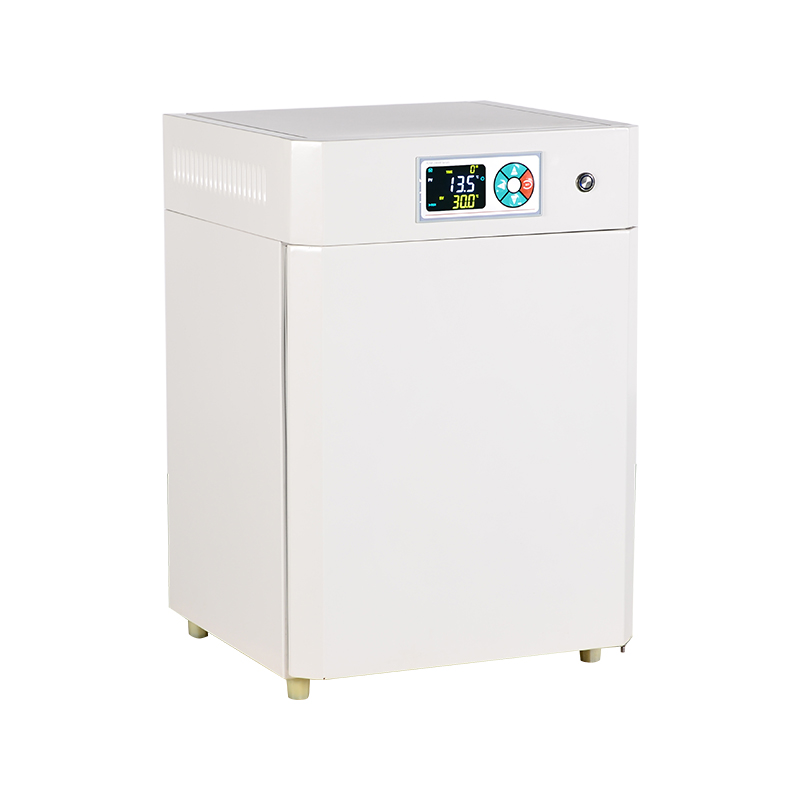
Dengsheng CO2 incubators are engineered for research and industrial laboratories requiring precise, stable cell culture environments. Available in a range of chamber volumes and actuation configurations, each model provides independent regulation of temperature, CO2 concentration, and relative humidity with digital monitoring and alarm output.
Key specifications include temperature control accuracy of ±0.1°C at 37°C, CO2 concentration control with IR sensor options for humidity-independent measurement, and relative humidity maintenance at 95% RH with rapid recovery after door opening. Stainless steel inner chambers with smooth welded seams minimize contamination harboring points; HEPA filtration systems are available across the product range for continuous bioburden reduction during operation.
For application-specific selection—including chamber volume, sensor type, decontamination cycle specification, and O2 control options—explore the full constant temperature incubator product range or contact Dengsheng's technical team with your culture requirements for a direct specification recommendation.
Send Message
Recommended Products
Products provided by famous enterprises are deeply trusted by users.


- CONTACT
-
- No. 119, Qingliang Avenue, Yaozhuang Town, Zhejiang, China.
- [email protected] ( Email )
- +86-13671719019 ( Phone )
- +86-021-57440136 ( Tel )
- PRODUCT
-
- Drying Oven Series
- Vacuum Box Series
- Explosion-proof Series
- High-temperature Furnace Series
- Incubator Series
- Test Chamber Series
- Other Series
- Forced Air Drying Oven
- Resistance Furnace
- Vacuum Tube Furnace
- Mold Incubator
- Vacuum Atmosphere Furnace
- Biochemical Incubator
- Carbon Dioxide Incubator
- Explosion-Proof Vacuum Drying Oven
- High and Low Temperature Test Chamber
- MOBILE
Copyright ©
Shanghai Dengsheng Instrument Manufacturing Co., Ltd.
All Rights Reserved. Laboratory Equipment Manufacturers

 Back to Top
