
 Español
  عربى
عربى 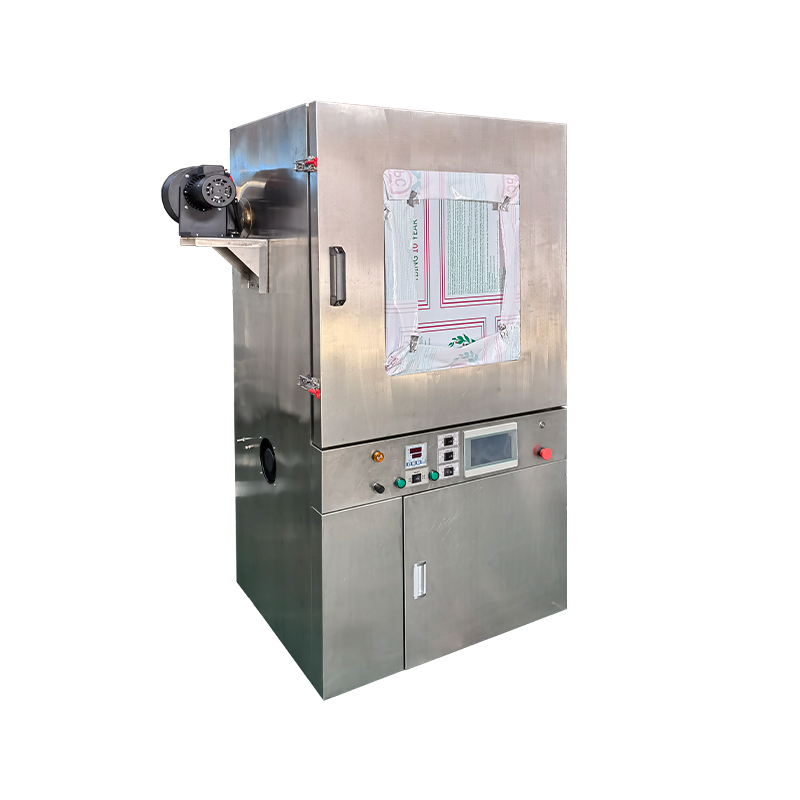



Industry News
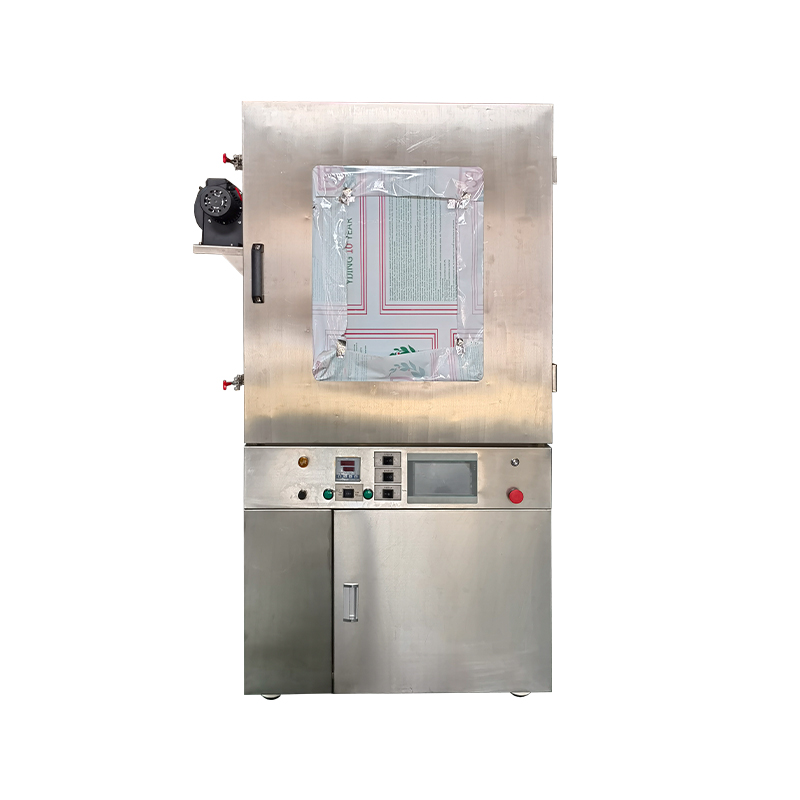
Air-Cooled Vacuum Drying Oven: Rapid Cooling & Precision Control
Date:Jul 13, 2026
The defining advantage of an air-cooled vacuum drying oven is its ability to execute the full thermal cycle—heating, vacuum drying, and forced cooling—inside a single sealed chamber without breaking vacuum or transferring samples. By integrating a forced air convection system with a vacuum-rated chamber, this equipment cuts total processing time by 40% to 60% compared to traditional vacuum ovens that require hours of natural cooling. The rapid cooldown phase not only accelerates throughput but prevents thermal oxidation and moisture reabsorption that occur when hot samples are exposed to ambient air.
Content
- 1 How Integrated Air Cooling Transforms the Drying Cycle
- 2 Vacuum Control and Pressure Regulation Intelligence
- 3 Modular Expansion for Process-Specific Demands
- 4 Materials of Construction and Vacuum Integrity
- 5 Application Domains Where Rapid Cooling is Non-Negotiable
- 6 Safety Interlocks and System Protections
- 7 Selecting the Right Capacity and Shelf Configuration
- 8 Maintaining Peak Performance Over Time
How Integrated Air Cooling Transforms the Drying Cycle
Conventional vacuum ovens rely on radiative heat dissipation through the chamber walls, a slow process governed by the thermal mass of the stainless steel interior. An air-cooled system bypasses this bottleneck. After the heating and soaking phases conclude, the heater disengages and a blower forces filtered ambient air through cooling channels jacketed around the chamber or directly across the exterior of the work zone. Simultaneously, the vacuum pump can continue running, pulling volatiles away as the product cools. The result is a cooling rate of 5°C to 10°C per minute from 200°C down to 60°C, versus the 1°C to 2°C per minute typical of unassisted natural cooling in an insulated chamber.
Thermal Uniformity During the Transition Phase
A critical quality metric often overlooked is the temperature spread across the shelf assembly during the cooldown ramp. Poorly designed air-cooled ovens create a thermal gradient where the edges chill faster than the center, warping sensitive substrates. Advanced models employ a baffle-and-plenum design that directs cooling air symmetrically across all shelf levels. In validated tests, a well-baffled chamber holds shelf temperature uniformity to ±3°C at 150°C under full vacuum, and maintains this tolerance even as the average temperature drops to 80°C. This consistency is vital when curing wafer-level coatings or drying pharmaceutical granulations where residual thermal stress alters dissolution profiles.
Vacuum Control and Pressure Regulation Intelligence
Precision drying is not simply about pulling the deepest vacuum possible. Many processes require a controlled bleed of inert gas to maintain a specific sub-atmospheric setpoint, a technique called vacuum level control or multi-step pressure profiling. The air-cooled vacuum drying oven integrates a proportional valve and a capacitance manometer to hold pressure at a precise setpoint, such as 100 Pa or 500 Pa, while heating. This gentle vacuum environment prevents violent boiling, skin formation on viscous polymers, and particle entrainment in powder beds. When the cooldown phase initiates, the system can automatically introduce dry nitrogen or argon to further suppress oxidation of oxygen-sensitive materials like lithium battery electrodes.
| Process Metric | Traditional Vacuum Oven | Air-Cooled Vacuum Oven |
|---|---|---|
| Cooling Method | Natural radiation/convection | Forced air jacket + vacuum hold |
| 200°C to 60°C Time | 120–180 minutes | 25–40 minutes |
| Sample Exposure Risk | High (door opening for faster cool) | None (sealed until end of cycle) |
| Pressure Control Range | On/off pump control | Proportional valve, ±10 Pa stability |
Modular Expansion for Process-Specific Demands
The architecture of modern air-cooled vacuum drying ovens is designed with modularity at its core, allowing laboratories and production lines to configure the equipment to exact process specifications rather than adapting processes to fit a rigid machine. The base unit provides the heating, vacuum, and air-cooling trifecta. From this foundation, users add modules that slot into the control logic and physical interfaces seamlessly.
Nitrogen Protection and Inert Atmosphere Control
For lithium-ion battery research, powder metallurgy, or oxygen-sensitive chemical synthesis, the nitrogen protection module is essential. It automates a sequence of evacuation and nitrogen backfill cycles to reduce residual oxygen inside the chamber to below 20 ppm. During the rapid cooling phase, a continuous low-flow nitrogen purge maintains positive pressure against atmospheric ingress while the cooling jacket extracts heat. This prevents the formation of lithium carbonate on cathode material surfaces, a degradation pathway that sharply reduces specific capacity.
Programmed Temperature and Pressure Sequencing
A multi-segment programmer allows the operator to define ramp rates, soak times, vacuum levels, and cooling profiles in a linked chain. A typical sequence for solvent removal from a heat-sensitive active pharmaceutical ingredient might involve: ramp to 45°C at 2°C/min under atmospheric pressure with nitrogen trickle, soak for 60 minutes, pull vacuum to 50 kPa absolute while holding temperature, ramp to 80°C at 1°C/min, soak at 80°C and full vacuum for 4 hours, then initiate forced air cooling to 30°C while maintaining vacuum. Such a profile prevents the molten intermediate phase from foaming, a common cause of batch loss in lyophilization-adjacent processes.
High-Efficiency Oil Fume Filtration
When drying mechanical parts, metal powders, or composite prepregs, volatile organic condensates can migrate into the vacuum pump, degrading oil quality and reducing ultimate vacuum. An oil fume filtration module installed on the exhaust line uses a coalescing filter element followed by activated carbon adsorption to trap >99% of oil mist and heavy hydrocarbon vapors before they reach the pump. This extends rotary vane pump oil life from a few cycles to several months and maintains the pump's ability to reach 10 Pa ultimate pressure.
Materials of Construction and Vacuum Integrity
The long-term reliability of an air-cooled vacuum drying oven hinges on the quality of the chamber construction and the sealing system. The interior work zone is typically fabricated from SUS304 stainless steel with a 2B finish, argon arc welded at all seams, and helium leak tested to ensure a leak rate below 1×10⁻⁸ Pa·m³/s. The door seal employs a double-lip silicone or Viton gasket held in a dovetail groove, compressed by a cam-lock or swing-bolt mechanism. A poorly maintained gasket with hairline cracks will allow micro-leaks that sabotage vacuum level and allow moisture ingress. Routine inspection of the gasket under a UV light after a fluorescent dye penetrant test is a recommended preventive maintenance step every 500 cycles.
Application Domains Where Rapid Cooling is Non-Negotiable
Several industries have adopted air-cooled vacuum drying ovens as a standard platform because their quality metrics correlate directly with cooling rate and post-process handling conditions.
- Lithium Battery Electrode Drying: NMP solvent removal from coated foils requires a vacuum drying step at 120°C followed by rapid, moisture-free cooling to prevent PVDF binder crystallization changes. Air-cooled ovens deliver dry electrodes with residual moisture consistently below 100 ppm.
- Semiconductor Packaging: Epoxy die-attach materials outgas during cure. Cooling under vacuum before exposure to cleanroom air prevents the uncured resin at the fillet from absorbing airborne amines, which cause subsequent delamination at the leadframe interface.
- Pharmaceutical Granulate Drying: Wet granulation destined for tablet compression must be dried to a loss-on-drying specification of <2%. Cooling the granulate in a vacuum environment locks in the amorphous structure of the active ingredient, preventing conversion to a less soluble crystalline polymorph.
- Additive Manufacturing Post-Processing: Polymer powder bed fusion parts require depowdering and drying. Rapid vacuum cooling of the build cake reduces the thermal history of unsintered powder, improving its recyclability ratio for subsequent builds.
Safety Interlocks and System Protections
Because the air-cooled vacuum drying oven handles elevated temperatures, negative pressures, and sometimes flammable vapors, safety is engineered in layers. Over-temperature protection uses a separate, independent thermocouple that cuts power to the heaters if the primary controller fails. A vacuum rupture disk or spring-loaded relief valve prevents the chamber from experiencing positive pressure if the cooling air path becomes blocked while the chamber is sealed. Electrical cabinets are purged or intrinsically safe-rated when the oven is configured for solvent drying. The cooling fan motor is interlocked with a flow sensor; if airflow drops below a minimum threshold, the heater is inhibited to prevent localized hot spots on the chamber exterior skin.
Selecting the Right Capacity and Shelf Configuration
Chamber size dictates the thermal load and the cooling airflow requirements. Under-specifying the cooling blower for a large chamber results in a marginal cooling rate that defeats the purpose of the air-cooled design. A properly sized system maintains the rated cooling slope even with a full thermal load of stainless steel trays and product. Standard benchtop models with a 25-liter to 50-liter chamber volume suit R&D and pilot-scale work. Floor-standing units ranging from 100 liters to 500 liters address small-batch production. Shelf spacing should be adjustable to accommodate varying product heights, and the shelf material must be selected for the chemical environment; electropolished 316L shelves resist chloride corrosion from hydrochloride salt off-gassing during API drying.
Maintaining Peak Performance Over Time
The air-cooled vacuum drying oven requires a disciplined maintenance schedule to preserve its performance edge. The cooling air intake filter must be replaced monthly in dusty production environments to prevent fin fouling on the heat exchanger. Vacuum pump oil requires spectroscopic analysis every three months to detect dissolved volatiles that indicate a failing coalescing filter. The door gasket should be cleaned with isopropyl alcohol after every batch that involves volatile condensates, as dried residue creates micro-channels for air leakage. Calibration of the vacuum gauge and temperature sensors against NIST-traceable standards should occur semi-annually. Neglecting these simple interventions gradually erodes the cooling rate and vacuum depth until the equipment's signature advantage—speed without contamination—is lost.
Send Message
Recommended Products
Products provided by famous enterprises are deeply trusted by users.

- CONTACT
-
- No. 119, Qingliang Avenue, Yaozhuang Town, Zhejiang, China.
- [email protected] ( Email )
- +86-13671719019 ( Phone )
- +86-021-57440136 ( Tel )
- PRODUCT
-
- Drying Oven Series
- Vacuum Box Series
- Explosion-proof Series
- High-temperature Furnace Series
- Incubator Series
- Test Chamber Series
- Other Series
- Forced Air Drying Oven
- Resistance Furnace
- Vacuum Tube Furnace
- Mold Incubator
- Vacuum Atmosphere Furnace
- Biochemical Incubator
- Carbon Dioxide Incubator
- Explosion-Proof Vacuum Drying Oven
- High and Low Temperature Test Chamber
- MOBILE
Copyright ©
Shanghai Dengsheng Instrument Manufacturing Co., Ltd.
All Rights Reserved. Laboratory Equipment Manufacturers

 Back to Top
