
 Español
  عربى
عربى 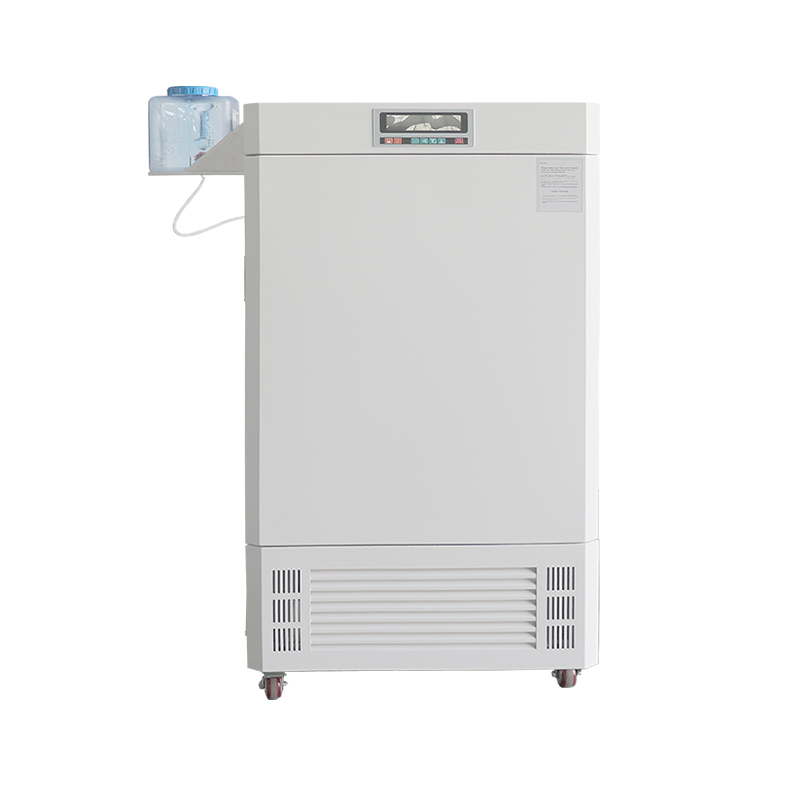



Industry News
Home / News / Industry News / Constant Temperature and Humidity Incubator: Principles & Applications
Constant Temperature and Humidity Incubator: Principles & Applications
Date:May 26, 2026
Most laboratory failures blamed on "bad reagents" or "inconsistent protocols" trace back to something more fundamental: the environment changed and nobody noticed. Humidity dropped 15% overnight as ambient conditions shifted. Temperature crept 1.5°C above setpoint during a summer afternoon. These deviations are invisible without dedicated monitoring—and they are impossible to prevent with a standard heating incubator. A constant temperature and humidity incubator is built specifically to hold both parameters simultaneously, under active control, regardless of what happens in the room around it.
This distinction matters far beyond cell biology. From pharmaceutical stability testing to electronic component aging to seed germination research, the combination of precise temperature and controlled humidity defines experimental validity.
Content
- 1 Why Temperature Alone Is Never Enough: The Case for Humidity Control
- 2 How the Four Core Systems Work Together
- 3 Humidification Technologies: Ultrasonic vs Electrode Steam
- 4 Temperature and Humidity Ranges: Matching Specs to Your Application
- 5 Industry Applications: Pharma, Electronics, Agriculture, and Food
- 6 Selection Checklist: 6 Questions Before You Buy
- 7 Dengsheng Constant Temperature and Humidity Incubators
Why Temperature Alone Is Never Enough: The Case for Humidity Control
A standard heating incubator controls temperature. What it cannot prevent is the cascade of humidity-driven effects that occur in any real experimental environment—effects that grow more significant the longer an experiment runs.
Consider a pharmaceutical stability study. A drug formulation stored at 40°C in a basic heating incubator experiences not only the specified thermal stress but also whatever humidity the ambient laboratory provides—which fluctuates with seasons, HVAC cycles, and occupancy. At 30% RH, hygroscopic tablet coatings crack and active ingredients degrade through pathways that never appear at 75% RH. At 90% RH, moisture-sensitive API crystals absorb water, converting to less stable polymorphic forms. Without humidity control, the stability data cannot be reproduced in another laboratory or compared across studies—it is confounded by an uncontrolled variable.
The same logic applies in electronics testing (component failure modes change dramatically between 20% and 85% RH), textile and packaging evaluation (material mechanical properties are humidity-dependent), and biological cultivation (germination rates, fungal sporulation, and insect development all respond to humidity independently of temperature). A constant temperature and humidity incubator removes this confounding variable entirely.
How the Four Core Systems Work Together
Maintaining a stable internal environment against the constant variation of ambient conditions requires four active systems operating in continuous dynamic balance. Understanding each one clarifies what the specifications on a product datasheet actually represent in practice.
- Heating system: PTC heaters or stainless steel heating tubes distribute heat uniformly across the chamber. PID (proportional-integral-derivative) controllers modulate output power continuously rather than switching on and off, minimizing temperature overshoot and undershoot. The heating system's response speed determines how quickly the chamber recovers from a door opening or load change.
- Cooling system: A vapor-compression refrigeration cycle—compressor, condenser, expansion valve, and evaporator—provides active cooling when the setpoint is below ambient or when humidity control requires dehumidification. The cooling system's capacity determines the lowest achievable temperature and the speed of temperature drop when loading warm samples. Environmentally acceptable refrigerants (R134a, R410A) are now standard across laboratory-grade equipment.
- Humidification system: Adds moisture to the chamber air to raise relative humidity toward setpoint. Two technologies dominate: ultrasonic humidification (a piezoelectric transducer generates a fine mist from water) and electrode steam humidification (current passed through water generates steam directly). Each has distinct performance characteristics discussed in the next section.
- Dehumidification system: Removes moisture when RH exceeds setpoint. Cooling-based dehumidification—cooling chamber air below its dew point to condense and drain excess moisture—handles medium-to-high humidity ranges. For applications requiring very low humidity levels, rotary desiccant dehumidification provides deeper moisture removal than cooling alone can achieve.
The precision of the overall system depends on how tightly these four loops are coordinated. A well-engineered constant temperature and humidity incubator uses sensor feedback from temperature and humidity probes simultaneously, adjusting all four systems in real time rather than treating them as independent control loops. Lag between the systems—where the humidifier fires after the heater has already changed the dew point—is the primary source of setpoint oscillation in lower-quality units.
Humidification Technologies: Ultrasonic vs Electrode Steam
The humidification technology has a direct impact on response speed, water quality requirements, maintenance burden, and the risk of microbial growth in the water circuit. Choosing between ultrasonic and electrode steam humidification should be based on the specific application requirements:
| Characteristic | Ultrasonic Humidification | Electrode Steam Humidification |
|---|---|---|
| Operating principle | Piezoelectric vibration creates cool mist from water | Electrical current heats water to generate steam |
| Response speed | Fast — mist generation is nearly instantaneous | Moderate — steam generation requires heating lag |
| Water quality requirement | Distilled or deionized water required; mineral deposits clog transducer | Tap water acceptable; minerals aid conductivity |
| Microbial risk | Higher — cool water reservoir can support growth if not maintained | Lower — boiling temperature sterilizes water continuously |
| Energy consumption | Lower | Higher |
| Best suited for | Applications requiring rapid RH recovery; clean-room environments | Biological cultivation; applications prioritizing microbial safety |
For biological cultivation applications—seed germination, insect rearing, microbial culture—electrode steam humidification is generally preferred because the boiling process eliminates the microbial growth risk inherent in cool-mist ultrasonic systems. For materials testing and pharmaceutical stability studies where microbial contamination is not a concern, ultrasonic humidification's faster response and lower energy use make it the practical choice.
Temperature and Humidity Ranges: Matching Specs to Your Application
Constant temperature and humidity incubators span a wide range of specifications, and selecting an appropriately sized unit—rather than the most capable one available—is sound engineering practice. Oversized equipment costs more to purchase and operate, and control precision often degrades at the extremes of a unit's rated range.
The most common specification ranges and their corresponding applications are:
- 0°C to 60°C / 40% to 95% RH: The standard range for biological cultivation, pharmaceutical stability testing (ICH guidelines call for 25°C/60% RH and 40°C/75% RH as primary test conditions), and food shelf-life validation. Most laboratory applications fall within this window.
- -10°C to 70°C / 20% to 98% RH: Extended range for cold-chain stability testing, low-humidity electronics aging, and specialized agricultural research. The ability to maintain humidity below 40% RH requires dedicated dehumidification capacity that basic models do not provide.
- -20°C to 80°C / 10% to 98% RH: High-specification range for automotive component testing, aerospace material qualification, and accelerated weathering protocols. These units typically incorporate larger refrigeration systems and more sophisticated dehumidification.
Temperature uniformity within the chamber—not just accuracy at the sensor—is the specification that matters most for spatial reproducibility across multiple samples. A unit with ±0.5°C uniformity will produce measurably different results between samples placed at the top versus bottom of the chamber. For critical applications, specify uniformity of ±0.3°C or better and verify it with an independent multi-point logger before committing to a unit.
Industry Applications: Pharma, Electronics, Agriculture, and Food
The constant temperature and humidity incubator occupies a central position in quality assurance and research workflows across several industries, each with distinct parameter requirements and regulatory contexts:
- Pharmaceutical stability testing: ICH Q1A guidelines define the storage conditions (temperature and humidity) at which drug products must be tested to support regulatory submissions. Long-term stability studies at 25°C/60% RH and accelerated studies at 40°C/75% RH are the most common conditions. Incubators used for these studies must demonstrate validated performance over multi-year periods, with audit-trail data logging for GMP compliance.
- Electronics reliability testing: JEDEC and IEC standards define temperature-humidity stress tests for semiconductor devices, PCB assemblies, and connectors. The 85°C/85% RH "85/85" test is a standard accelerated life test for moisture-induced failure modes including corrosion, delamination, and electrochemical migration. Automotive electronics must meet more stringent thermal cycling requirements across the -40°C to +125°C range.
- Agricultural and life science research: Seed germination studies, plant growth experiments, and insect behavioral research all require stable, programmable temperature-humidity environments that can simulate seasonal or diurnal cycles. Programmable multi-segment profiles—ramping temperature and humidity over 24-hour cycles—enable researchers to replicate specific geographic climates or phenological triggers with high reproducibility.
- Food safety and packaging validation: Shelf-life studies for packaged foods require controlled temperature and humidity storage that replicates distribution and retail conditions. Packaging material permeability testing under defined environmental conditions supports claims about moisture barrier performance.
Selection Checklist: 6 Questions Before You Buy
Specifying the right constant temperature and humidity incubator before purchase avoids the common outcome of discovering a performance gap after the equipment is installed and experiments are underway. Work through these six questions systematically:
- What temperature and humidity range do your protocols actually require? Identify the minimum, maximum, and most common setpoints—not just the extreme requirements. A unit rated to -20°C is unnecessary and more expensive if your lowest setpoint is 10°C.
- What uniformity specification is acceptable across your sample array? If you run 20 samples simultaneously and need comparable results across all positions, specify uniformity rather than accuracy at the sensor. Request multi-point uniformity mapping data from the manufacturer.
- What humidity precision does your application require? Standard stability testing typically accepts ±5% RH; sensitive biological cultivation may require ±3% RH. Higher precision requires better sensors and more tightly tuned control loops.
- Does your application require programmable profiles or only fixed setpoints? Simple stability testing runs at constant conditions; agricultural simulation and accelerated aging often require temperature and humidity to change on a schedule. Confirm that the controller supports the number of program segments your protocols need.
- What data interface does your quality system require? Regulated industries require traceable data logging with audit trails. Confirm the incubator's data output format (RS-485, USB, Ethernet, cloud connectivity) is compatible with your laboratory information management system before purchasing.
- What is the internal volume needed for your typical batch? Allow 30–40% headspace above the actual sample volume for airflow. Overpacking a chamber reduces uniformity; systematic underuse of a large chamber wastes operating cost and floor space.
Dengsheng Constant Temperature and Humidity Incubators
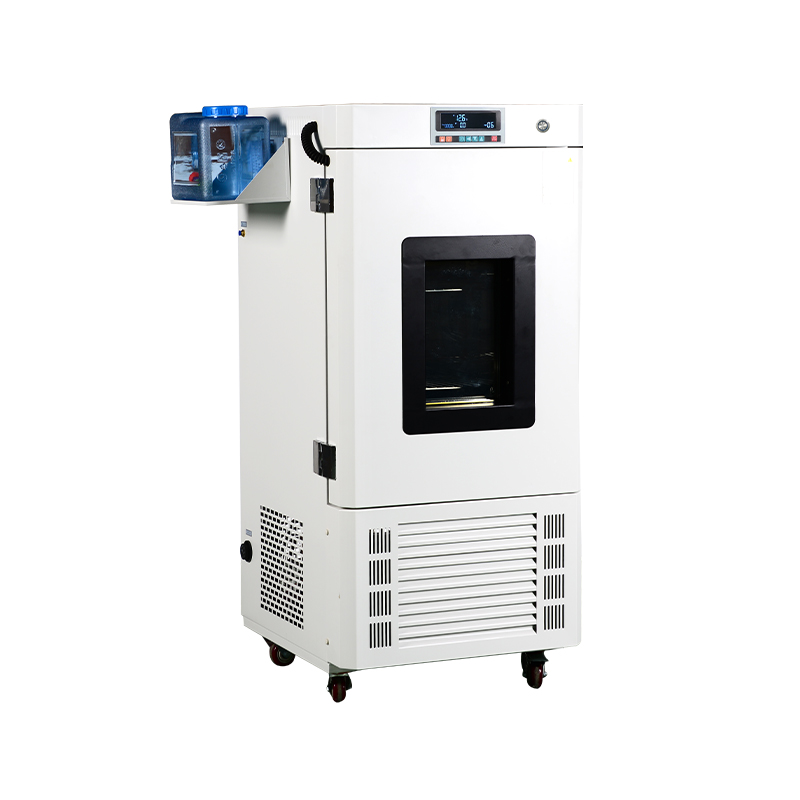
Dengsheng constant temperature and humidity incubators are designed for laboratory and industrial applications requiring simultaneous, precise control of both environmental parameters. Built around PID-controlled heating and cooling systems with integrated humidification and dehumidification, each model maintains temperature accuracy of ±0.1°C and humidity precision of ±3% RH under stable operating conditions.
Standard models cover the 0°C to 60°C temperature range and 40% to 95% RH humidity range; extended-range configurations are available for low-temperature and low-humidity applications. All models incorporate PT100 temperature sensing for high accuracy, stainless steel inner chambers for chemical resistance and easy cleaning, and digital controllers with multi-segment programming capability for time-variable protocols. RS-485 data output interfaces are standard, supporting integration with laboratory data management systems and GMP-compliant audit-trail logging.
For full specifications, chamber volume options, and application-specific configuration guidance, visit the constant temperature incubator product range or contact Dengsheng's engineering team directly with your protocol requirements.
Send Message
Recommended Products
Products provided by famous enterprises are deeply trusted by users.


- CONTACT
-
- No. 119, Qingliang Avenue, Yaozhuang Town, Zhejiang, China.
- [email protected] ( Email )
- +86-13671719019 ( Phone )
- +86-021-57440136 ( Tel )
- PRODUCT
-
- Drying Oven Series
- Vacuum Box Series
- Explosion-proof Series
- High-temperature Furnace Series
- Incubator Series
- Test Chamber Series
- Other Series
- Forced Air Drying Oven
- Resistance Furnace
- Vacuum Tube Furnace
- Mold Incubator
- Vacuum Atmosphere Furnace
- Biochemical Incubator
- Carbon Dioxide Incubator
- Explosion-Proof Vacuum Drying Oven
- High and Low Temperature Test Chamber
- MOBILE
Copyright ©
Shanghai Dengsheng Instrument Manufacturing Co., Ltd.
All Rights Reserved. Laboratory Equipment Manufacturers

 Back to Top
