
 Español
  عربى
عربى | I. Equipment Purpose and Compliance Standards | ||
| Equipment meets requirements | Complies with GB/T 30435-2013 standard for electric hot-air drying ovens, GB 5959.4-92 manufacturing safety standard, and GB/T 20033-2011 standard for hot-air circulation ovens. | |
| 2. Product Application | Suitable for conducting heat resistance, humidity resistance, dryness resistance, high and low temperature adaptability testing, low-temperature constant-temperature maintenance, and storage for electronic and electrical products, surface treatments, instruments and gauges, plastics, metallurgy, and similar applications. Particularly suitable for high and low temperature adaptation testing of products including optical fibres, crystals, precision inductors, surface-treated components, PCBs, and LCDs; also serves as a reliability testing apparatus for quality control engineering. Additionally applicable for quality supervision bureaus, research institutions, and higher education establishments to evaluate product performance and quality. | |
| 3. Strictly prohibited products | The following items are strictly prohibited for testing: flammable and explosive substances, highly corrosive materials, and items emitting strong radiation. | |
| II. Equipment Specifications | ||
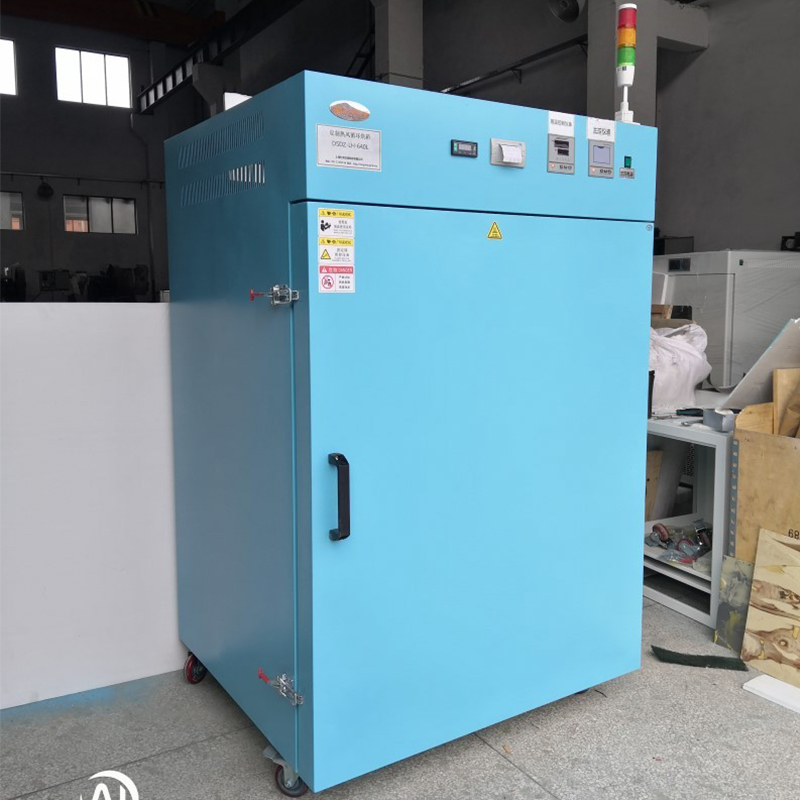
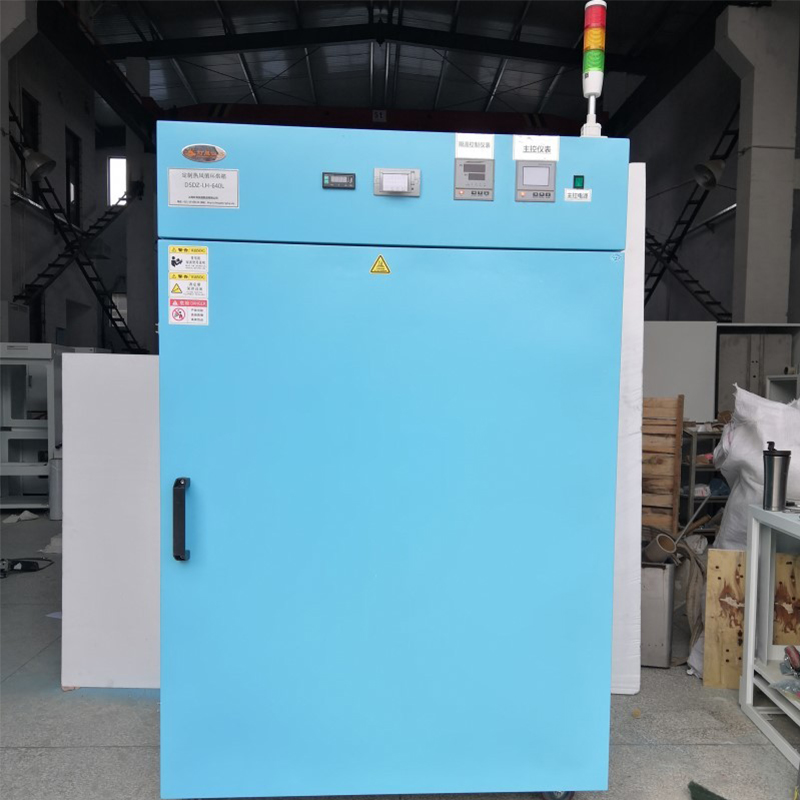
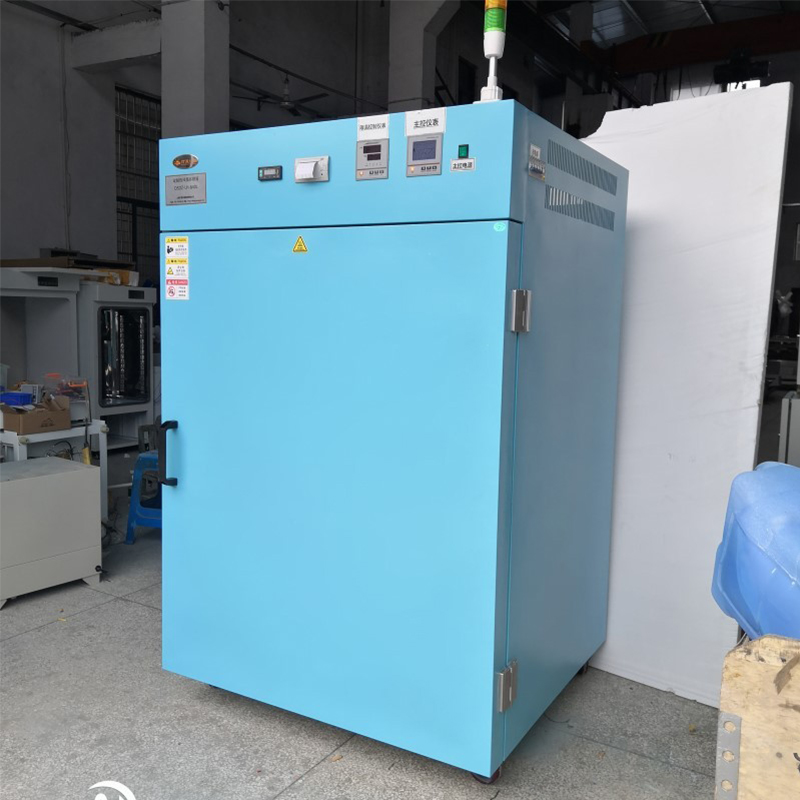
| 1. Equipment Name | Customised Hot Air Circulation High-Temperature Oven | |
| 1. Equipment Model | DS-LH135 | |
| 2. Key Technical Specifications | ||
| Custom Hot Air Circulation Oven | ||
| 2.1 Inner chamber dimensions | 800 × 800 × 1000 mm (width × depth × height) | |
| 2.2 External dimensions | 1000 × 1050 × 1690 mm | |
| 2.3 Temperature range | RT + 50 to 600 °C | |
| 2.4 Long-term operating temperature | <550 | |
| 2.5 Temperature fluctuation | ±1 °C | |
| 2.6 Temperature uniformity | ±2.5% of reading | |
| 2.7 Heating rate | Room temperature to 550 °C <85 min | |
| 2.8 Temperature resolution | 1 °C | |
| 2.9 Temperature uniformity | 200°C: ±2°C, 300°C: ±3°C, 400°C: ±5°C, 500°C: ±6°C | |
| 2.9 Power supply rating (approx.) | 220V/50Hz | |
| 2.10 Total power consumption | Approximately 4kW | |
| 2.11 Sample holder | Three stainless steel perforated folded-edge (double-blade) mesh plates | |
| 3. Equipment Structural Performance | ||
| 3.1 Enclosure Structural Materials | Structure | The interior features an angle steel frame for structural reinforcement. Layers from outer to inner are: cabinet shell – insulating rock wool – frame – air duct – inner chamber – sample rack. The control system is housed in an external controller box mounted on the right side of the unit. The fan motor is installed atop the equipment, driving the circulation fan via a V-belt. |
| Outer casing material | The outer casing employs cold-rolled steel plate with electrostatic powder coating. | |
| Inner liner material | Constructed from premium SUS321 stainless steel plate. | |
| Door lock | Features a double-latch door lock for ease of use. | |
| Insulation layer | 5052 aluminium oxide insulating flame-retardant wool. | |
| Support feet | Nylon feet. | |
| Door | Single door configuration without viewing window, featuring a snap-lock mechanism for ergonomic operation. Door frame sealing utilises specially formulated high/low-temperature resistant silicone rubber gaskets for enhanced sealing integrity. | |
| 3.2 Air Distribution and Circulation System | Fan | Utilising branded high-temperature resistant fans combined with high-temperature resistant aluminium alloy circulation fans to achieve forced convective diffusion circulation. |
| Fan drive | Triangular belt transmission. | |
| Duct circulation | The duct circulation employs an upper intake with left and right exhaust return air design. The installation of baffles within the duct ensures both air pressure and velocity comply with testing standards, whilst enabling rapid temperature stabilisation upon door opening and closing. | |
| Test port | None. | |
| 3.3 Heating System | ① | The heating system employs a hot-air circulation heating method, ensuring uniform temperature distribution with precise and reliable temperature control. |
| ② | Both temperature control and power output are calculated by a microcomputer, which automatically adjusts heating power according to internal load levels. This achieves high precision and energy efficiency, resulting in greater environmental sustainability and energy savings. | |
| ③ | Primary system components: heating tubes, solid-state relays, etc. | |
| 4 Fault Alarm System (Optional) | ||
| Equipment Safety Protection | Independent temperature limiter automatically cuts off heating upon overheating, accompanied by audible and visual alarms to alert the operator, effectively safeguarding samples. | |
| 5. Overview of Selected Electrical Components | ||
| Instrumentation | LCD integrated horizontal block instrument displays multiple sets of data on a single screen with stable and accurate signal transmission. The instrument features PID logic operation, offering both self-tuning and manual adjustment capabilities. | |
| Solid-state relay | Utilises high-quality solid-state relays | |
| Temperature sensor | Employs PT100 sensors | |
| 6. Technical Documentation | ||
| Manuals | Equipment user manual, warranty card, certificate of conformity, electrical schematic diagram, | |
| 7. Optional Accessories | ||
| Data storage | USB storage, spreadsheet data storage | |
| Printer | Thermal paper printing, adjustable print interval | |
| Inert gas filling port | Internal U-shaped distribution, aperture 16mm (outer diameter) | |
| Gas flow meter | Control gas channel to regulate gas flow rate | |
| Operational indicator light | Three-colour indicator (operational status, fault status, over-temperature status) | |
| III. Equipment Environment Installation Requirements | ||
| Equipment Installation Requirements | Ambient temperature and humidity: 5°C to +30°C, relative humidity: <85% | |
| No intense vibrations in the vicinity | ||
| No direct sunlight or other direct heat sources | ||
| No strong electromagnetic fields in the vicinity | ||
| No high concentrations of dust or corrosive substances in the vicinity | ||
| The room must be well ventilated. | ||
| No strong air currents in the vicinity; where forced airflow is required, the airflow must not be directed onto the unit. | ||
| The equipment must be placed on a solid, level surface and maintained in a horizontal position. | ||
| A clearance of at least 50cm must be maintained between the rear of the equipment and the wall, with at least 50cm clearance on both sides. | ||
| IV. Acceptance and Warranty | ||
| Parameters | All data above was measured during operation under no-load conditions. | |
| Acceptance | Acceptance inspection shall be completed within one week of the equipment arriving at the buyer's designated delivery address. | |
| Warranty | A 12-month warranty period applies following acceptance. Beyond this period, reasonable charges will apply for replacement parts. | |
| V. Production Lead Time and Transportation Method | ||
| Production Lead Time | Delivery within 45 working days from the date the advance payment is credited to the supplier's account. | |
| Transportation Method | Road transport; delivery in transport packaging compliant with QB/WD008-2001 standards. Delivery location: Customer's designated point (excluding upstairs delivery). Unloading of bags to be undertaken by the buyer. |
|


Customized Drying Oven
Customized Drying Oven
2025-12-18
Custom-Made High-Temperature Oven
Machine
Send Message

- CONTACT
-
- No. 119, Qingliang Avenue, Yaozhuang Town, Zhejiang, China.
- [email protected] ( Email )
- +86-13671719019 ( Phone )
- +86-021-57440136 ( Tel )
- PRODUCT
-
- Drying Oven Series
- Vacuum Box Series
- Explosion-proof Series
- High-temperature Furnace Series
- Incubator Series
- Test Chamber Series
- Other Series
- Forced Air Drying Oven
- Resistance Furnace
- Vacuum Tube Furnace
- Mold Incubator
- Vacuum Atmosphere Furnace
- Biochemical Incubator
- Carbon Dioxide Incubator
- Explosion-Proof Vacuum Drying Oven
- High and Low Temperature Test Chamber
- MOBILE
Copyright ©
Shanghai Dengsheng Instrument Manufacturing Co., Ltd.
All Rights Reserved. Laboratory Equipment Manufacturers

 Back to Top
